
Here’s a question worth asking: How many of your current members regularly visit your synagogue’s website just to see what’s going on?
Probably fewer than you might think.
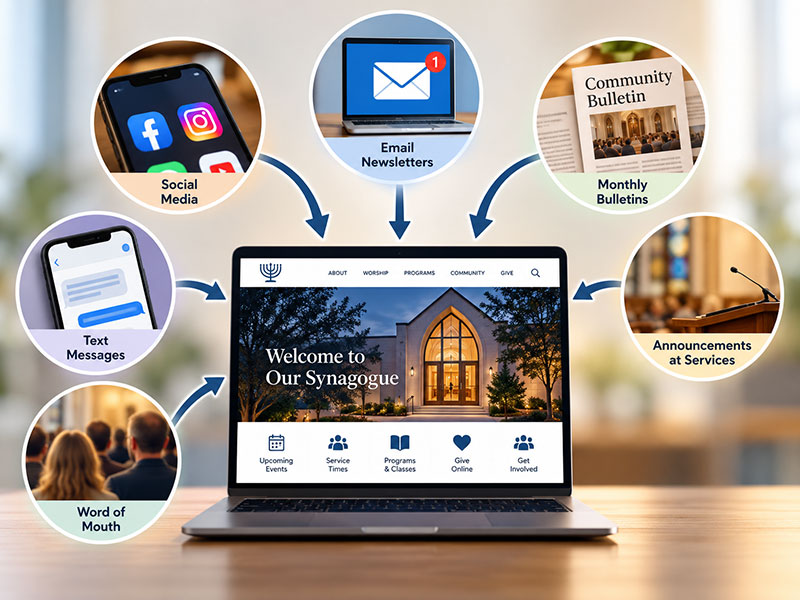
For most synagogue members, the website may not be their primary source for discovering what’s happening in the community. Instead, they’re hearing about upcoming programs, services and events through other channels: the weekly email newsletter, a monthly bulletin, social media, text or WhatsApp groups, announcements from the bimah, or simply word of mouth.
They see an event in Thursday’s email and click the link. They notice something on Facebook or Instagram and follow it back to the website. A friend mentions a program, so they Google the synagogue and look for more information.
In other words, the website often isn’t where the journey begins. But it’s still an important part of the journey.
Your Website Is the Hub, Even When It Isn’t the Starting Point
I think one mistake synagogues can make is assuming that members interact with their website the same way they might interact with a news site: visiting the homepage regularly to see what’s new.
Some certainly do. But many members probably aren’t typing the synagogue’s URL into their browser every few days to check for upcoming programs.
Instead, your other communication channels are doing much of the work of bringing information to them.
That doesn’t make the website less important. In some ways, it makes the website’s role clearer.
Your email newsletter, social media accounts and other communications can push information out. Your website is the central place where that information lives.
An email might contain a short description of an upcoming program and a “Learn More” or “Register” button. That button should lead somewhere useful.
A social media post might catch someone’s attention. When they want the complete details—time, location, cost, registration information, speaker bio or anything else—the website should have them.
And if someone does go directly to the website looking for what’s happening this week, they should be able to find that information easily too.
There Are Still Plenty of Direct Visitors
It would also be a mistake to assume that nobody uses the website directly.
Some members absolutely do.
There may even be a generational component to this. Different members develop different habits around how they get information. One person may religiously read every synagogue email. Another may primarily follow the congregation on Facebook. Someone else may simply know that if they want to find Friday night service times or see what programs are coming up, they can go to the website.
And habits change.
Someone who normally relies on the weekly email may delete it accidentally—or remember seeing something in it but not remember the details. Rather than searching through their inbox, they go to the website.
The important thing is that a synagogue shouldn’t design its communications around a single path to information.
Members are going to come at it from different directions.
So Yes, Put the Information on the Website
Sometimes I hear a variation of this argument:
“We already put all of this in our weekly email. Do we really need it on the website too?”
My answer is yes.
Not because every member is going to visit the website every week, but because the website serves a different purpose.
An email newsletter is temporary. Social media posts quickly disappear down a feed. A printed bulletin eventually gets recycled. A text message gets buried beneath dozens of other conversations.
The website is persistent.
It gives your synagogue one reliable place to point people for the most current information.
That means upcoming events should be there. Service times should be there. Holiday information should be there. Registration links should be there. Giving opportunities should be there. Changes to schedules should be there.
And ideally, the information across all of those channels should work together rather than compete with one another.
Think “Hub and Spokes”
I like to think of synagogue communications as a hub-and-spoke system.
The website is the hub.
Your email newsletter, social media, monthly bulletin, text messages and other communications are the spokes. They’re often better at reaching people proactively because they put information in front of members rather than waiting for members to come looking for it.
But whenever possible, those communications can lead people back to the website for the full story.
Instead of putting every detail about an event into an already-long weekly email, provide the essentials and link to the event page.
Instead of trying to squeeze all the information into an Instagram graphic, use the post to generate interest and direct people to the website.
That approach also makes life easier when something changes. Rather than having multiple versions of the same information floating around, the website can serve as the authoritative source.
And Don’t Forget About the People Who Aren’t Members Yet
There’s another reason all of this information belongs on the website: your members aren’t the only people reading it.
A prospective member isn’t receiving your weekly newsletter yet. They may not follow your synagogue on social media. They’re probably not in the congregation’s WhatsApp group.
They are, however, likely to visit your website.
And what they find there tells them something about your community.
A robust calendar of programs says that this is an active congregation. Current service information tells them they can actually show up. Photos and descriptions of recent and upcoming programs help them picture themselves participating.
So information that may feel routine or purely functional to an existing member can simultaneously serve as marketing to a prospective one.
An upcoming Shabbat dinner isn’t just information your members need. To someone considering joining, it can be evidence of a warm and active community.
The Website Doesn’t Have to Do All the Work
The goal shouldn’t necessarily be to train every synagogue member to check the website every morning.
That’s probably unrealistic—and unnecessary.
Instead, think of the website as the central source of truth for your synagogue’s public information, while recognizing that different communication channels will bring different people there at different times.
Send the weekly email.
Post on social media.
Publish the monthly bulletin.
Use whatever communication methods work for your congregation.
But keep the website current too.
Because your members may not start there every time.
They should always be able to end up there.