
Best Practices for Promoting Events on Your Synagogue Website
Synagogues have a lot going on.
Shabbat dinners. Adult education. Holiday celebrations. Social programs. Guest speakers. Religious school events. Social action projects. Brotherhood and sisterhood programs. Fundraisers.
And everyone organizing one of those programs understandably wants people to know about it.
That makes promoting events one of the most important jobs of a synagogue website — and one of the easiest things to get wrong.
The goal isn’t to put as much event information as possible on the homepage. It’s to help people discover what’s happening, understand why they might want to participate and easily find the information they need to take the next step.
Here are some best practices for doing that well.
1. Don’t Turn Your Homepage Into an Event Calendar
Your homepage is valuable real estate.
It’s tempting to use most of it to promote everything happening at the synagogue over the next few weeks. But when event after event competes for attention, the homepage can quickly become overwhelming.
Remember that not everyone visiting your homepage is looking for an event.
Someone may be considering joining your congregation. Someone else wants to know when Shabbat services begin. A parent may be looking for religious school information. Another visitor may simply be trying to understand what kind of synagogue you are.
Events should have a prominent place on the homepage — but they shouldn’t be the homepage.
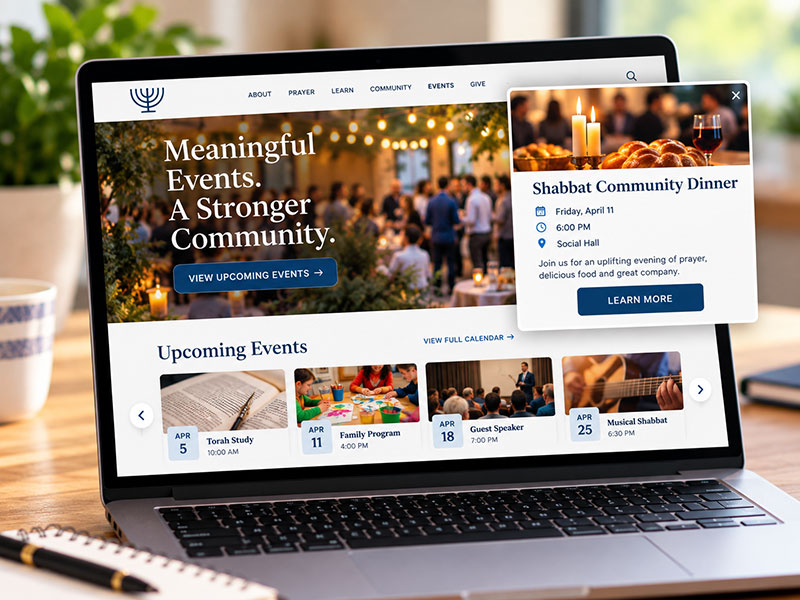
Feature a manageable selection of upcoming programs and provide an obvious link to your complete calendar or events page.
That gives current members quick access to what’s happening without allowing your synagogue’s identity to disappear behind a wall of announcements.
2. Give Events a Consistent Place to Live
Visitors shouldn’t have to figure out where you decided to put events this week.
Create a consistent area of the homepage for upcoming programs. That might be a row of event cards, a carousel or another design that fits naturally into the site.
Consistency helps in two ways.
First, regular visitors learn where to look when they want to see what’s coming up.
Second, it prevents each new event from becoming a new design project. You shouldn’t have to rearrange the homepage every time someone wants to promote a program.
The structure stays the same. The events change.
3. Use the Homepage to Promote the Event — Not Explain Everything About It
Think of an event promotion on your homepage as an invitation.
It needs to give someone enough information to become interested, but it doesn’t need to provide every detail.
Usually, that means:
-
A clear event title
-
The date and time
-
A compelling photograph or graphic
-
A sentence or two explaining what the event is
-
A clear call to action
That’s enough.
The speaker’s complete biography, parking instructions, registration deadline, pricing structure, Zoom information and every other detail can live on the event page.
Your homepage should say, “This looks interesting.”
The event page can say, “Here’s everything you need to know.”
4. Don’t Use Event Flyers as Website Content
This is one of the most common synagogue website mistakes.
Someone creates a flyer for an upcoming program. It gets emailed to the congregation, printed for the lobby and posted on social media.
Then that same flyer gets uploaded to the homepage.
The problem is that a flyer designed for a printed page isn’t designed for a website — particularly a website viewed on a phone.
Reduce an 8½-by-11-inch flyer to the width of a mobile screen and the text can become nearly impossible to read. Multiple flyers also introduce different fonts, colors and visual styles, quickly making the homepage feel cluttered and inconsistent.
The information from the flyer belongs on the website.
The flyer itself usually doesn’t.
Use the event’s photograph or artwork if appropriate, then present the title, description, date and registration information as actual website content.
It will be easier to read, easier to navigate and much more consistent with the rest of your site.
5. Give Every Important Event Its Own Destination
When someone clicks an event on the homepage, where do they go?
Ideally, they should arrive at a page or calendar listing containing everything they need to know.
That might include a fuller description, date and time, location, cost, speaker information, registration instructions, accessibility information and a contact person.
For a relatively simple event, your website calendar may provide everything you need.
A major program might benefit from its own dedicated page.
Either way, avoid making the full-size event flyer the destination. Someone who has expressed enough interest to click deserves something more useful than a larger version of the same image.
6. Make the Next Step Obvious
What should someone do after learning about the event?
Register. Join Us. Learn More. RSVP. Purchase Tickets.
Use a call to action that tells visitors what happens next.
“Click Here” technically works, but it doesn’t tell anyone what they’re clicking for.
The call to action should also lead as directly as possible to the next step. If someone needs to register, don’t send them through three additional pages before they reach the registration form.
Every unnecessary step creates another opportunity for someone to give up.
7. Make Event Information Work on a Phone
A member receives your weekly email while waiting in line at the grocery store.
They see an interesting program and tap the link.
What happens next?
If they arrive at a tiny event flyer, a complicated registration form or a page where the important information is buried, you’ve made something simple unnecessarily difficult.
Event information should be designed with mobile visitors in mind.
Make the date and time easy to spot. Keep text readable. Use buttons that are easy to tap. Test registration forms on a phone.
This is particularly important because emails, text messages and social media — some of the most effective ways of promoting synagogue programs — are frequently viewed on mobile devices.
8. Let People Add Events to Their Own Calendars
Once someone decides to attend, make it easy for them to remember.
Whenever possible, allow visitors to add an event to their personal calendar.
That small convenience moves the event from something they saw on your website to something that’s now part of their own schedule.
It also reduces the likelihood that they’ll need to return later to figure out what time the program begins or where it’s being held.
9. Automate Where It Makes Sense
Your staff shouldn’t have to enter the same event information over and over again.
If you’re already adding an event to your website calendar, consider whether selected upcoming events can automatically feed into the homepage.
This can save staff time while helping ensure that the homepage stays current.
Automation also makes it easier to remove events when they’re over. Instead of relying on someone to remember that last Tuesday’s program is still sitting on the homepage, the system can simply stop displaying it.
That doesn’t mean everything needs to be automated.
You may still want control over which events receive special attention or how they’re presented.
The best approach often combines automation with editorial judgment.
10. Remember That Your Website Is Only One Part of Event Promotion
Your members may not wake up every morning and visit the synagogue website to see what’s new.
They may learn about programs through your weekly email, a monthly bulletin, social media, text messages, announcements from the bimah or conversations with friends.
That’s perfectly fine.
Those communication channels can bring people back to the website when they want more information or are ready to register.
That makes the website the reliable home for the event, even when it isn’t where someone first hears about it.
Your email doesn’t need to contain every detail. Your social media post doesn’t need to explain everything. Give people a reason to be interested, then provide a clear path back to the website.
The website can do the heavier lifting.
Promote What’s Happening Without Losing Who You Are
Programs are an important part of synagogue life.
They demonstrate that your congregation is active. They provide opportunities for learning, worship, celebration and connection. And for current members, upcoming events may be one of the primary reasons they interact with your website.
But your synagogue is more than its calendar.
Someone discovering your congregation for the first time also needs to understand your people, your clergy, your values and the kind of Jewish community you’ve created.
A good synagogue homepage makes room for both.
It shows visitors what’s happening without allowing what’s happening this week to overwhelm the larger story of who you are.
Promote your events.
Just don’t let them become your entire website.