
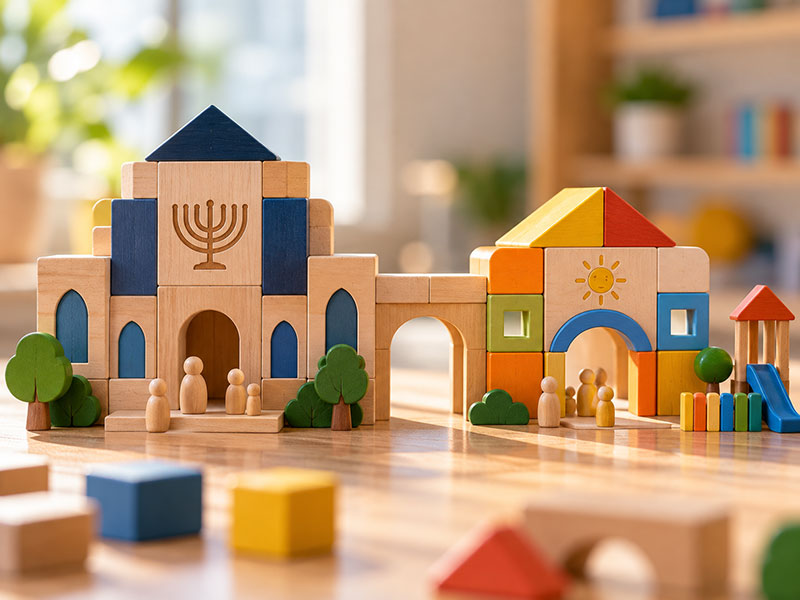
For many synagogues, the preschool or early childhood center is much more than another program.
It may have its own director and staff. Its own admissions process. Its own calendar and communications. Its own personality and visual identity.
And, importantly, its own audience.
Many preschool families may have little or no previous connection to the synagogue. In fact, the preschool may be their first introduction to the congregation — and the beginning of a relationship with the larger Jewish community.
That raises an interesting website question:
Should the preschool be part of the synagogue website, or should it have a website of its own?
There’s no universal answer.
Both approaches can work well. The right choice depends less on technology and more on how the preschool functions within the congregation.
First, Think About the Audience
This is probably the most important consideration.
Who is using the preschool website?
A synagogue website needs to serve a broad range of people: current members, prospective members, religious school families, worshippers, donors, program participants and others.
A preschool website has a much more focused audience.
Parents want to know:
What ages do you serve?
What are the hours?
What’s your educational philosophy?
What does a typical day look like?
Who are the teachers?
How do I schedule a tour?
How do I apply?
How much does it cost?
Those parents may not be synagogue members. Some may not be Jewish. Others may be Jewish but have no current synagogue affiliation.
Their relationship with your organization begins with the preschool.
The website structure should make their experience as simple as possible.
When Keeping the Preschool on the Synagogue Website Makes Sense
For many congregations, keeping everything together is the simplest and most logical approach.
If the preschool is relatively small and closely integrated into synagogue life, a dedicated section within the synagogue website may provide everything it needs.
There are real advantages.
You have one website to maintain. One hosting environment. One design system. One set of administrators.
The visual relationship between the preschool and synagogue is obvious, which can reinforce the idea that early childhood education is an important part of the congregation rather than a separate organization occupying the same building.
It can also make the transition from preschool family to synagogue family feel natural.
A parent who comes to the website looking for preschool information can easily discover Tot Shabbat, family programming, holiday celebrations and other opportunities within the larger congregation.
For a preschool that only needs a handful of pages — perhaps an overview, philosophy, programs, staff, admissions and contact information — a separate website may simply be unnecessary.
When a Separate Preschool Website Makes Sense
Other early childhood centers operate almost like organizations within organizations.
They may serve hundreds of children, employ a substantial staff and compete with other preschools throughout the community.
They may need extensive information about curriculum, individual age groups, admissions, tuition, summer programs, enrichment, calendars, parent resources and employment opportunities.
At that point, fitting everything underneath a single “Preschool” item in the synagogue navigation can become limiting.
A separate website gives the preschool room to organize information entirely around prospective and current preschool families.
The navigation can say:
About. Programs. Admissions. Our Teachers. Parent Resources. Schedule a Tour.
It doesn’t have to share space with Worship, Adult Learning, Membership, Social Action and everything else the synagogue needs to communicate.
The preschool can also develop a visual personality appropriate for an early childhood program while still maintaining a clear connection to the synagogue.
How Independent Is the Preschool’s Identity?
This is another useful question.
Some early childhood centers are unmistakably extensions of the synagogue.
They share the congregation’s name, branding and communications. Families understand from the beginning that they’re enrolling in the synagogue’s preschool.
Others have developed recognizable identities of their own.
They may have their own name, logo, director, social media presence and marketing efforts. Families may talk about the preschool by name rather than thinking of it primarily as “the synagogue preschool.”
Neither model is inherently better.
But the website should reflect the reality.
If the preschool already functions publicly as a distinct brand, giving it a distinct website may make sense.
If the preschool’s identity is intentionally intertwined with the congregation, separating the two too much could work against that relationship.
Don’t Let the Preschool Get Buried
If you decide to keep the preschool within the synagogue website, don’t treat it like a minor program.
For many prospective families, the preschool is the reason they’re visiting the website.
Make it easy to find from the main navigation.
Give the preschool a substantial landing page rather than a paragraph buried somewhere under “Education.”
Allow it to have its own sub-navigation if necessary.
Use strong photography of actual children and teachers.
Give prospective parents obvious next steps such as Schedule a Tour, Request Information or Apply.
The preschool can live inside the synagogue website without feeling buried inside it.
That’s an important distinction.
A Separate Website Shouldn’t Feel Like a Separate Organization
The opposite problem can happen, too.
A synagogue creates a separate preschool website and the connection between the two organizations nearly disappears.
Different logos. Different visual styles. Different language. Few links between the sites.
A prospective parent might spend twenty minutes exploring the preschool website without realizing that it’s part of a larger synagogue community.
That’s a missed opportunity.
Even when the preschool has its own website, there should be a thoughtful visual and navigational relationship between the two.
The websites don’t have to look identical.
In fact, they probably shouldn’t.
A preschool website can appropriately feel brighter, more playful and more focused on children and families.
But they should feel related.
Think of them as members of the same family rather than identical twins.
Remember the Bigger Opportunity
There’s another reason the relationship between the two websites matters.
For some families, preschool may be their entry point into synagogue life.
They enroll their child because they love the school.
Then they attend a family Shabbat program.
They celebrate a holiday with other preschool families.
They get to know the rabbi.
They make friends.
Eventually, they may begin thinking of themselves not simply as a preschool family, but as part of the synagogue community.
Your website can support that progression.
A preschool website can introduce synagogue family programs. The synagogue website can prominently feature the preschool. Both can provide natural pathways between the two.
Don’t treat them as unrelated audiences when, ideally, one may lead to the other.
What About Website Management?
There’s also a practical consideration: who is going to keep everything current?
If the preschool has its own director or administrative staff responsible for communications, a separate website may give them greater control over their content.
They can update admissions information, staff pages and program details without routing every change through the synagogue’s communications staff.
On the other hand, a small preschool without dedicated communications resources may benefit from being part of the synagogue’s existing website workflow.
Whichever structure you choose, make responsibility clear.
Who updates the preschool content?
Who handles technical maintenance?
Who approves larger changes?
Who makes sure information stays current?
The best website structure is one your organization can realistically maintain.
You Don’t Necessarily Need Two Completely Separate Systems
A separate public-facing preschool website doesn’t necessarily mean creating an entirely independent technical infrastructure.
Depending on how the synagogue website is built, the two sites can share hosting, technical management and other resources while maintaining separate public identities.
For organizations using WordPress, there are several ways to structure that relationship.
The technical architecture should follow the organizational need — not the other way around.
First decide whether visitors are better served by one website or two.
Then decide how to build it.
One Website or Two?
So, should your synagogue preschool have its own website?
Start with these questions:
- Does the preschool have a substantial amount of content of its own?
- Does it market itself to a broader audience beyond synagogue members?
- Does it compete with other local preschools for enrollment?
- Does it have its own staff responsible for communications?
- Does it have a distinct identity or brand?
- Would prospective parents benefit from navigation designed entirely around their needs?
- Can the organization realistically maintain another website?
The more often the answer is yes, the stronger the case for a separate preschool website.
If the preschool is smaller, closely integrated into synagogue life and doesn’t require extensive content of its own, a well-designed section within the synagogue website may be the better solution.
The important thing isn’t whether the preschool has its own domain name.
It’s whether prospective families can easily find what they need, understand what makes the preschool special and take the next step.
And whichever approach you choose, don’t lose sight of the relationship between the preschool and the synagogue.
The preschool may have its own audience.
But for many families, it can also be the front door to something much larger.