
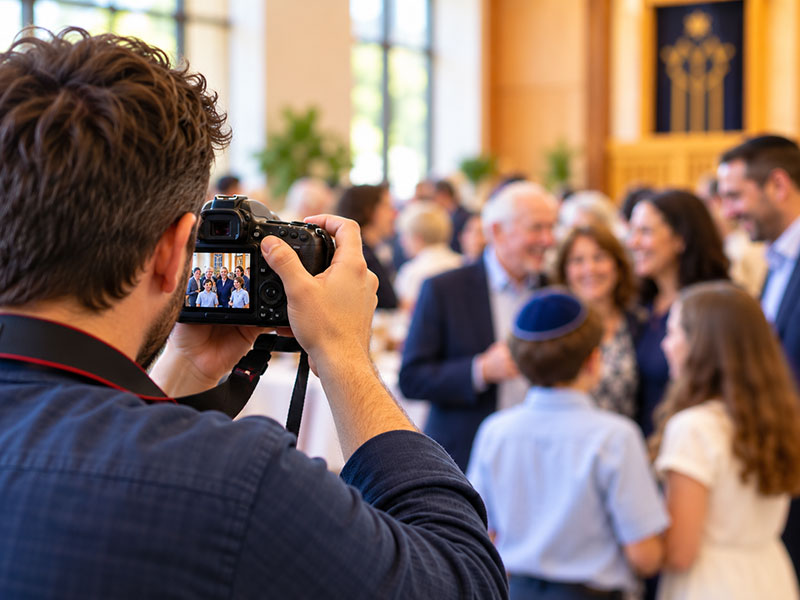
You can write that your synagogue is warm and welcoming.
You can describe a close-knit community, meaningful worship, joyful Jewish life and opportunities for people of every age to connect.
But a great photograph can communicate some of those things before a visitor reads a single word.
That’s why photography is one of the most important ingredients in a synagogue website.
The right photographs don’t simply make a website look better.
They help tell the story of your congregation.
Show People, Not Just Places
Synagogues often have beautiful spaces.
A striking sanctuary. Colorful stained glass. An impressive ark. A historic building.
Those photographs certainly belong on the website.
But they shouldn’t dominate it.
If someone is considering becoming part of your congregation, they’re probably less interested in what the building looks like when it’s empty than in what happens when it’s full of people.
Show congregants talking after services. Show children learning. Show adults studying together. Show clergy interacting with members. Show families celebrating and volunteers working side by side.
Your building is where community happens.
Your people are the community.
Look for Relationships, Not Just Crowds
When synagogues think about website photography, there’s often an assumption that bigger is better.
We need a photograph of a packed sanctuary!
We need to show hundreds of people at the Purim carnival!
Those images can certainly demonstrate that your congregation is active.
But some of the strongest website photographs capture much smaller moments.
Two people laughing together over an oneg.
A rabbi kneeling down to talk with a child.
A group of adults leaning into a conversation around a table.
A teacher helping a student.
Friends embracing after services.
Those photographs show something a crowd shot often can’t:
relationships.
And relationships are ultimately what someone considering a synagogue is looking for.
Help Visitors See Themselves in Your Community
Think about the collection of photographs on your website as a whole.
Who appears in them?
If nearly every image shows families with young children, what message does that send to an empty nester, a single adult or a couple without children?
If almost every photograph shows older adults, will a young family wonder whether there are people at a similar stage of life?
Your photographs should reflect the actual breadth of your congregation as honestly as possible.
That includes different ages, family structures and ways people participate in synagogue life.
You don’t need every photograph to represent everyone.
But taken together, the images should help a wide range of visitors think:
“There could be a place for me here.”
Capture Ordinary Synagogue Life
Don’t wait for the biggest event of the year to take photographs.
Some of the most useful images can come from ordinary moments of synagogue life.
An adult education class.
Religious school on a Sunday morning.
A social action project.
A casual congregational dinner.
A small-group gathering.
People talking over coffee.
These photographs can sometimes feel more authentic than images from major events because they show what belonging to the congregation actually looks like from week to week.
A prospective member isn’t only deciding whether they’d like to attend your biggest annual celebration.
They’re trying to imagine what it might feel like to be part of your community on an ordinary Tuesday evening or Saturday morning.
Give Your Photographer a Shot List
Whether you’re hiring a professional photographer or asking a talented congregant to help, don’t simply say, “Take some pictures for the website.”
Think ahead about what the website needs.
You might want:
- Wide horizontal photographs for homepage banners
- Smaller group interactions
- Clergy engaging with congregants
- Children and families
- Adult learning
- Worship and ritual
- Social action and volunteering
- Social gatherings
- Individual clergy and staff photographs
- Architectural details and ritual objects
- Plenty of images with open space where website text could potentially appear
This makes a photography session much more productive.
It also helps you avoid discovering later that you have 300 photographs from an event but none that actually work in the spaces available on the website.
Remember That Website Photos Need Room to Breathe
A beautiful photograph isn’t automatically a useful website photograph.
Website design often requires images to be cropped into different shapes.
A wide homepage banner may use only the middle portion of a photograph. A square image might be needed elsewhere. Text may need to appear over one side of an image.
That’s why tightly cropped photographs can be difficult to work with.
When taking pictures specifically for the website, leave some room around the subject.
And take both horizontal and vertical photographs when possible.
A little extra space gives the website designer much more flexibility.
What About Shabbat and Holiday Photography?
For many Conservative and Orthodox synagogues, some of the moments you’d most like to show on the website happen precisely when photography isn’t appropriate.
That can make authentic synagogue photography more challenging.
But it doesn’t make it impossible.
Look for opportunities outside Shabbat and holidays that still communicate community and Jewish life.
Photograph religious school, weekday learning, social events, volunteer projects, rehearsals, programs and gatherings before or after Shabbat.
You can also intentionally schedule a photography session.
Bring together congregants for a weekday program or another appropriate occasion and have someone capture natural interactions rather than stiff, posed photographs.
The goal isn’t to pretend something is happening that isn’t.
It’s to document authentic aspects of congregational life at times when photography is appropriate.
Your Members May Already Have Great Photographs
Before assuming you need an expensive photo shoot, ask around.
Congregants are taking photographs at synagogue events all the time. Staff members may have photos on their phones. Your religious school may have an archive. Someone in the congregation may be an accomplished amateur or professional photographer who’s happy to help.
Make it easy for people to share their best images.
You may be surprised by what already exists.
Just make sure you have appropriate permission to use photographs publicly, particularly when children are pictured.
Use Stock Photography Selectively
Stock photography can be useful.
Sometimes you need an image representing a concept that simply isn’t practical to photograph yourself. And a high-quality stock image can be far better than using a poor photograph simply because it happens to be authentic.
But stock photography should generally support the story of your synagogue rather than replace it.
Visitors can often recognize overly staged images.
The perfectly lit family in a pristine kitchen lighting Shabbat candles may be beautiful, but it doesn’t tell me anything about your congregation.
Whenever possible, use real photography for the parts of the website that are specifically about your community.
Use stock photography to fill the gaps.
Quality Still Matters
Authenticity doesn’t mean every photograph is worth using.
A blurry, dark or badly composed photograph isn’t necessarily helping your website simply because it shows real congregants.
Look for images that are sharp, well lit and visually interesting.
Modern phones are capable of taking excellent photographs, particularly in good lighting. You don’t necessarily need professional equipment.
What matters more is being intentional.
Pay attention to what’s in the background. Get closer to the people you’re photographing. Look for natural interactions. Take multiple shots rather than relying on one.
And whenever your budget allows, a professional photography session can be one of the best investments you make in a new website.
Those photographs can serve your congregation for years — not just on the website, but in email, social media, brochures and other communications.
Build a Photo Library, Not Just a Website
One of the best things a synagogue can do is make photography an ongoing habit.
Create a central place where strong, approved photographs are collected and organized.
Add to it throughout the year.
When someone takes a terrific photograph at a religious school program, save it. When you have professional photographs taken, preserve the full collection. When someone captures a wonderful moment at a volunteer project, add it to the library.
Then the next time you redesign a webpage, create an email campaign or promote a program, you’re not starting from scratch.
You already have a visual record of your community.
Let Your Community Tell the Story
The strongest synagogue websites don’t simply say that there’s a meaningful community behind them.
They show it.
They show relationships.
They show learning.
They show celebration.
They show Jewish life happening among actual people.
Good writing helps explain what makes your synagogue distinctive.
Good photography lets visitors see some of it for themselves.
And for someone who hasn’t walked through your doors yet, that glimpse of real community may be one of the most powerful invitations your website can offer.