
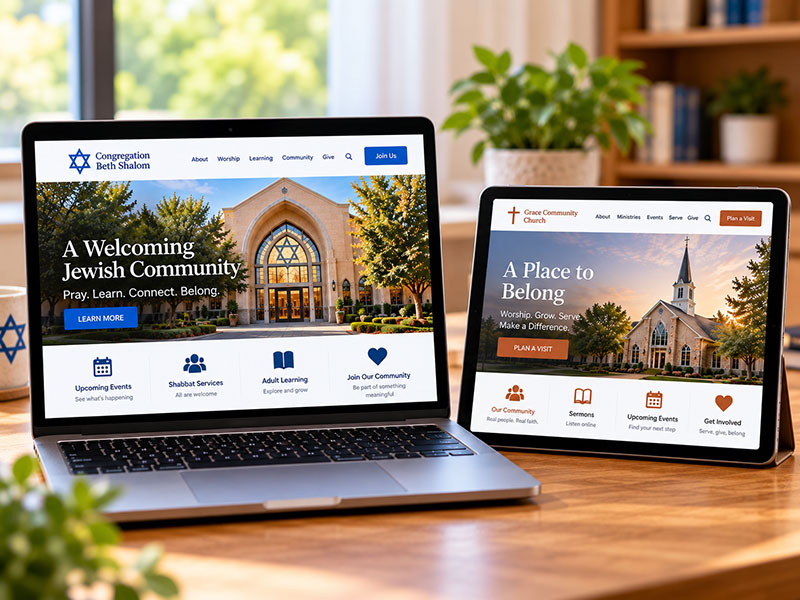
Churches and synagogues are obviously different institutions, with different traditions, cultures and ways of building community.
But when it comes to their websites, they face some remarkably similar challenges.
Both need to provide practical information to the people who already belong. Both need to communicate what they believe and value. And both need to introduce themselves to people who may be searching for a spiritual community but haven’t walked through their doors yet.
Over the years, some of the best church websites have been particularly effective at that last part.
They don’t simply tell visitors what’s happening this weekend. They communicate a sense of purpose, show real people and relationships, speak directly to newcomers and make it easy to imagine becoming part of the community.
There are some valuable lessons there for synagogue websites, too.
1. Lead With Who You Are, Not Just What’s Happening
Visit many synagogue homepages and you’ll immediately encounter upcoming events.
A Shabbat dinner. An adult education class. A social action project. A concert. A religious school program.
All of those things are important. But together, they don’t necessarily answer a more fundamental question:
What kind of congregation is this?
Some of the most effective church websites answer that question almost immediately. Their homepages are organized around a clear sense of mission and identity rather than simply the next several events on the calendar.
Synagogues can do the same.
What matters most to your congregation? What kind of Jewish community are you trying to create? What distinguishes the experience of being part of your synagogue?
You don’t necessarily need a formal mission statement at the top of the homepage. In fact, a long institutional mission statement probably isn’t the answer.
Instead, your values and identity should shape the story the homepage tells.
Your programs then become evidence of that larger story.
A social action project isn’t simply another event to promote. It demonstrates your congregation’s commitment to repairing the world. An adult education class reflects a culture of lifelong Jewish learning. A Shabbat dinner shows the importance you place on relationships and community.
Start with the bigger picture.
Then show visitors how the things you do bring it to life.
2. Speak to the Person Visiting the Website
Synagogue websites often speak about themselves.
“We are a warm and welcoming congregation.”
“We offer a wide variety of programs.”
“We have served the Jewish community for more than 75 years.”
There’s nothing inherently wrong with those statements. But compare them with language that speaks directly to the person reading the page:
Find your place in our community.
Join us for Shabbat.
There’s a place for you here.
The difference is subtle, but important.
One describes the institution. The other begins a conversation.
Church websites have often been very good at using this kind of outward-facing language. Synagogues can learn from that without copying the particular language, theology or style of a church website.
Think about the visitor on the other side of the screen.
What might they be looking for? What might make them hesitant? What would help them feel invited to take the next step?
Writing with that person in mind can make a synagogue website feel much more personal.
3. Show Real People and Real Community
Photography is one of the most powerful tools available to a synagogue website.
And yet congregations sometimes devote more visual attention to their building than to the people inside it.
A beautiful sanctuary photograph can certainly have a place. So can images of Torah scrolls, ritual objects and architectural details.
But if you’re trying to communicate what it feels like to belong to your congregation, show people.
Show friends talking at an oneg. Show children learning. Show clergy interacting with congregants. Show adults studying together, families celebrating and volunteers working side by side.
These don’t need to be photographs of huge crowds or extraordinary occasions.
Ordinary moments can tell an extraordinary story about a community.
Quality matters, too. A small collection of strong, well-composed photographs will usually do more for a website than dozens of dark, blurry or outdated images.
The goal isn’t simply to make the website prettier.
It’s to help someone looking at the screen think, “I can imagine myself there.”
4. Focus on Community, Not Just Programming
This may be the most important lesson of all.
Synagogues do a lot of programming, and naturally we want people to know about it.
But there’s a difference between showing that your congregation is active and allowing the website to become a bulletin board.
Someone considering joining a synagogue probably isn’t choosing a Jewish community because it has the greatest number of events next month.
They’re looking for something deeper.
Will I meet people here?
Will my children feel comfortable?
Will I find meaningful Jewish experiences?
Will there be people at a similar stage of life?
Can I learn here? Pray here? Celebrate here?
Could this become my community?
Your website can’t answer all of those questions definitively. But it can show visitors that your synagogue understands them.
Events still belong on the website. Upcoming programs should still be easy to find.
They just shouldn’t be the entire story.
5. Make It Easy for Someone New to Begin
Church websites frequently devote significant attention to the first-time visitor.
Synagogues can benefit from doing the same.
A longtime member already knows what “Kabbalat Shabbat” means at your congregation. They know which entrance to use, where to park and whether people generally arrive five minutes early or fifteen minutes late.
A newcomer doesn’t.
Your website can remove some of that uncertainty.
Consider providing an obvious place for someone who’s new to begin. Explain when services are held, what they can expect, whether they need to contact anyone beforehand and how they can learn more about the congregation.
And don’t make “Join” the only next step.
Someone discovering your synagogue may not be ready to become a member. They may simply want to attend a service, come to a program, meet the rabbi, sign up for your emails or ask a question.
Give them an easy first step.
Then let the relationship develop from there.
6. Connect Inspiration With Action
A beautiful photograph and a compelling message can capture someone’s interest.
Then what?
If you’re telling visitors about the joy of celebrating Shabbat together, give them an easy way to find your service schedule.
If you’re showing families engaged in Jewish life, provide a clear path to information about religious school or family programming.
If you’re describing a community built around lifelong learning, help visitors discover upcoming classes and learning opportunities.
Good website design connects the emotional and the practical.
Here’s what our community is about. Here’s what it looks and feels like. And here’s how you can experience it for yourself.
That’s where storytelling and functionality come together.
Your Synagogue Is More Than the Next Event on the Calendar
There’s a broader lesson behind all of this.
A synagogue website has two important audiences.
Current members often arrive with a task. They want a service time, an event registration form, a calendar, a livestream link or information about something that’s happening.
Prospective members are often doing something very different.
They’re trying to understand you.
They’re looking for clues about your values, your people, your clergy and your community. They’re wondering whether your synagogue might be a place where they could belong.
A great synagogue website needs to serve both.
That’s something the best church websites have understood particularly well: provide the information people need, but don’t let the information overwhelm the story you’re trying to tell.
Synagogues don’t need to look like churches or communicate like churches.
But we can learn from websites that do an effective job of turning an unfamiliar institution into a community someone wants to know more about.
Ultimately, that’s what a synagogue website should do, too.