
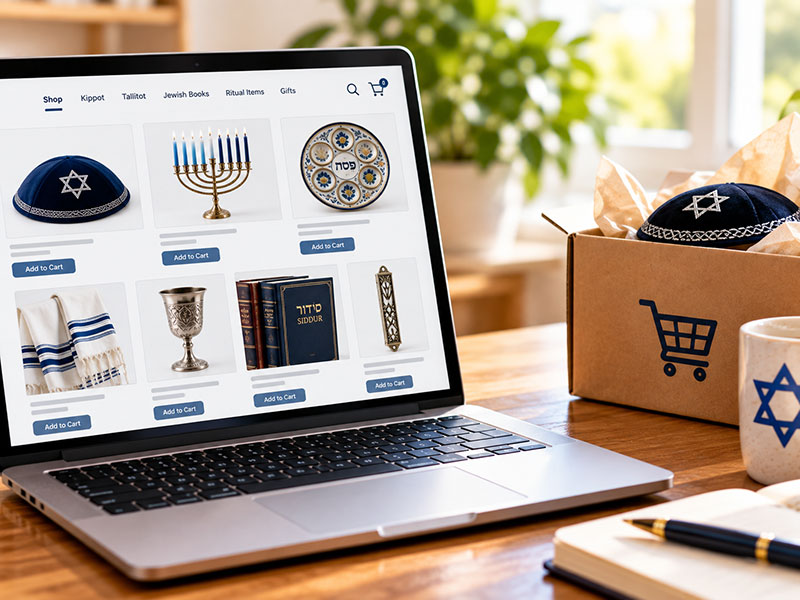
Synagogue gift shops occupy an interesting place in congregational life.
They’re a convenient source for Judaica, holiday items, gifts and ritual objects. They often provide an important source of revenue for the synagogue or an affiliated organization. And in many congregations, they’re lovingly managed by volunteers who put considerable time into selecting merchandise and helping members find just the right thing.
There’s just one problem.
They’re usually closed.
A synagogue gift shop might be open on Sunday mornings during religious school, for a few hours during the week or by appointment.
But people don’t necessarily decide they need a mezuzah, wedding gift or new seder plate during those particular hours.
That’s where an online store can help.
Make the Gift Shop Available When People Want to Shop
One of the biggest advantages of an online synagogue gift shop is simply convenience.
A congregant realizes at 9:00 at night that they need a bar mitzvah gift for the weekend.
Someone is preparing for Hanukkah and wants to see what the synagogue has available.
A grandparent wants to purchase something for a grandchild but can’t get to the building during regular gift shop hours.
With an online store, they can browse whenever it’s convenient.
That doesn’t necessarily mean the order needs to be shipped immediately — or even shipped at all. Customers might purchase online and pick up their order at the synagogue.
The important thing is that the opportunity to shop isn’t limited to the handful of hours when the physical store is staffed.
Make It Easier for Members to Support the Synagogue
Many synagogue members would genuinely prefer to purchase Judaica from their congregation rather than from a large online retailer.
But convenience matters.
If buying something from the synagogue requires calling the office, arranging an appointment and visiting the building during a particular window of time, while purchasing the same type of item elsewhere takes a few clicks, even the most supportive member may choose the easier option.
An online store removes some of that friction.
If you want congregants to support the synagogue gift shop, make supporting it easy.
Reach Beyond the People Already Walking Through Your Building
A physical gift shop primarily serves people who are already at the synagogue.
An online store doesn’t have that limitation.
Someone may discover your store while searching online for Judaica. A former member who has moved away may still want to support the congregation. A relative of a congregant may be looking for a Jewish gift. Someone in your community who doesn’t belong to a synagogue may simply be searching for a local source for Judaica.
This can be particularly useful in communities without a dedicated Judaica store nearby.
Your synagogue doesn’t need to become the next major online Judaica retailer.
But making your inventory available online can turn a resource that was previously available only to people walking through the building into something accessible to the larger community.
Help People See What You Actually Have
Even members who know your synagogue has a gift shop may have no idea what’s in it.
Do you carry mezuzot?
Kiddush cups?
Candlesticks?
Children’s gifts?
Jewelry?
Holiday items?
Wedding and b’nai mitzvah gifts?
Unless someone regularly walks through the store, they may never know.
An online store doubles as a browsable catalog.
Someone can see what’s available before visiting the synagogue, discover something they didn’t know you carried or send a product link to a family member.
That visibility has value even when the eventual purchase happens in person.
You Don’t Have to Put Everything Online
One concern about creating an online store is the amount of work involved.
A synagogue gift shop may contain hundreds of individual items, some of which change frequently. Photographing, describing and maintaining every piece of inventory can become a substantial project.
You don’t necessarily need to do that.
Start with the things that make the most sense online.
Feature popular Judaica, holiday merchandise, gifts or items that are relatively easy to keep in stock. Create collections around occasions such as weddings, b’nai mitzvah or Hanukkah.
You can always expand over time.
An online store doesn’t have to reproduce every shelf and display case in the physical shop to be useful.
Make Online and In-Person Shopping Work Together
An online store doesn’t need to replace your physical gift shop.
In fact, the two can complement each other.
Someone might browse online and then visit the synagogue to see an item in person. Another person might notice something while they’re in the building and purchase it online later. A member might order from home and pick it up after religious school on Sunday.
You can also use the website to tell people when the physical store is open and whom to contact if they’re looking for something they don’t see online.
Think of the online store as another entrance to the same gift shop.
Keep the Shopping Experience Simple
Like everything else on a synagogue website, ease of use matters.
People should be able to browse products, understand what they’re purchasing and complete an order without unnecessary steps.
Product photographs should be clear. Descriptions should provide the information someone actually needs. Categories should make sense. And the checkout process should work comfortably on a phone.
Don’t make someone create an account unless there’s a compelling reason to require one.
And be clear about fulfillment.
Is the item being shipped? Is local pickup available? When will the customer be notified? Where should they go to pick it up?
A small synagogue gift shop doesn’t need a sophisticated ecommerce operation.
It needs a shopping experience that’s straightforward and reliable.
Decide Who Will Manage It
The technology is only part of running an online store.
Someone still needs to know when an item sells.
Someone needs to keep inventory reasonably accurate.
Someone needs to fulfill the order, arrange pickup or ship the merchandise.
And someone needs to update products when items sell out or new merchandise arrives.
Before launching an online store, decide how those responsibilities will work.
For many synagogue gift shops, the answer may be relatively simple: an email notification goes to the gift shop chair or volunteer, who prepares the order for pickup.
The online system doesn’t need to make the operation more complicated.
Ideally, it should make it easier.
What About Shabbat?
For some congregations, accepting purchases online during Shabbat or Jewish holidays may raise religious questions.
Because an online store can process transactions automatically around the clock, Orthodox congregations and others that follow traditional halachic practices may want to discuss with their rabbi how the store should function during those times.
The website can then be configured to reflect the congregation’s practice.
That’s one more reason the technology shouldn’t dictate how the synagogue operates.
It should adapt to the synagogue.
Extend the Gift Shop Beyond Its Four Walls
Your synagogue gift shop may already be a wonderful resource.
Putting it online doesn’t change what makes it special.
It simply makes it easier to access.
Members can shop when it’s convenient. People can discover merchandise they didn’t know you carried. The larger Jewish community can find you. And the synagogue has another opportunity to generate revenue from a resource that already exists.
The physical gift shop can remain exactly what it has always been: a place to browse, ask questions and get personal help finding the right Judaica or gift.
The online store just keeps the door open a little wider.