
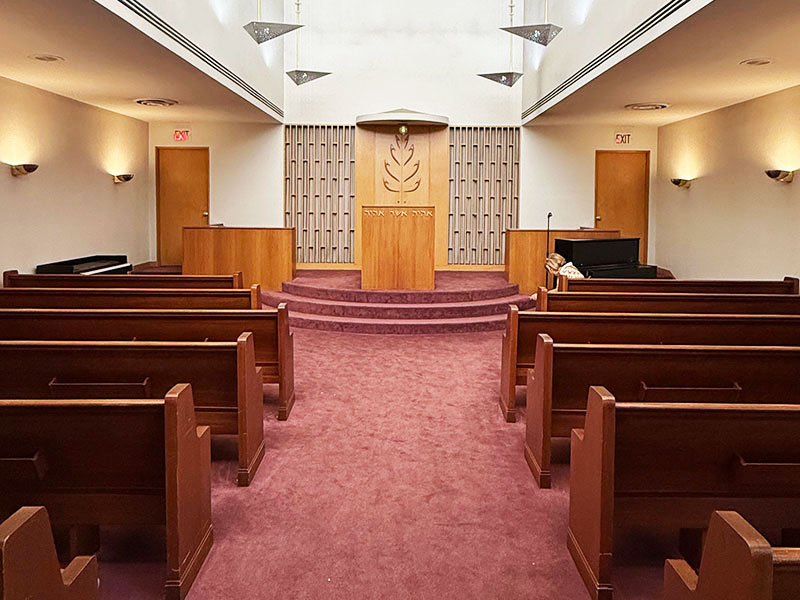
Synagogues often have beautiful sanctuaries.
Stained glass. An impressive ark. Meaningful architectural details. Rows of seats facing a bimah where generations of congregants have prayed, celebrated and marked important moments in their lives.
Naturally, when it’s time to build a synagogue website, someone takes a photograph of the sanctuary.
And sometimes that photograph ends up being one of the most prominent images on the homepage.
There’s nothing inherently wrong with that.
But there’s a question worth asking:
What does an empty sanctuary tell someone about your congregation?
Probably less than you think.
People Don’t Join Buildings
Your building may be important to your congregation.
It may have history. Members may feel deeply connected to it. The sanctuary may be beautiful and filled with memories.
But someone looking for a synagogue isn’t primarily looking for a building.
They’re looking for a community.
They’re wondering whether they’ll meet people. Whether they’ll feel comfortable. Whether there are others at a similar stage of life. Whether they’ll find meaningful Jewish experiences and relationships.
A photograph of an empty sanctuary can’t answer those questions.
A photograph of your people might.
Show What Happens in the Sanctuary
Instead of thinking about the sanctuary as the subject of the photograph, think about it as the setting.
What happens there?
People pray.
Children sit beside their parents.
Clergy teach and lead.
Families celebrate b’nai mitzvah.
Congregants sing together.
People greet one another before services and linger afterward.
Those are the moments that give the room its meaning.
A sanctuary filled with people tells a completely different story from the exact same sanctuary photographed empty.
One says, “Here’s our building.”
The other says, “Here’s our community.”
Empty Spaces Can Send an Unintended Message
Website visitors interpret photographs quickly.
They aren’t necessarily stopping to consciously analyze what each image means. They’re simply forming an impression.
That’s why photographs of empty spaces can sometimes work against the message you’re trying to communicate.
You may describe your congregation as warm, vibrant and connected while the photographs show empty rows of chairs, vacant classrooms and deserted social halls.
The words and images are telling two different stories.
That’s especially noticeable on a homepage, where photography plays such an important role in establishing the feeling of the website.
If you want visitors to see community, show community.
This Doesn’t Mean You Should Never Show an Empty Sanctuary
Here’s where I’d soften the old rule.
There are times when an empty sanctuary photograph works beautifully.
Perhaps your sanctuary has extraordinary stained glass or a distinctive ark. Maybe the architecture is historically significant. A beautifully composed photograph might communicate spirituality, history or a sense of place.
Those images can absolutely belong on the website.
They may work particularly well on a page about your history, facilities, worship or building.
An architectural detail can also make a wonderful background or supporting design element.
The point isn’t “never show an empty room.”
It’s “don’t make an empty room the primary visual representation of your community.”
That’s an important difference.
The Same Rule Applies Beyond the Sanctuary
It’s not only sanctuaries.
An empty religious school classroom doesn’t tell me much about your educational community.
Show children learning with a teacher.
An empty social hall doesn’t tell me what congregational life feels like.
Show people sitting around tables talking and laughing.
An empty playground isn’t nearly as compelling as children actually using it.
A photograph of your library may be attractive, but people studying together in that library tell a richer story.
Whenever you’re deciding between photographing a place and photographing what happens in that place, the second option will usually tell visitors more about your congregation.
What If You Can’t Photograph During Shabbat?
This is an especially important consideration for Conservative and Orthodox congregations.
Some of the moments you’d most like to show—worship, Torah reading, congregants gathered together on Shabbat—happen at times when photography may not be appropriate.
That doesn’t mean your website has to be filled with empty rooms.
Synagogue community happens throughout the week.
Photograph religious school. Adult learning. Social programs. Volunteer projects. Weekday services when appropriate. Clergy talking with congregants. Families gathering for programs. People preparing for holidays.
You can also arrange an intentional photography session at an appropriate time.
The goal isn’t to stage a fake Shabbat service.
It’s to capture authentic people and relationships in the many other settings where synagogue life happens.
Small Moments Often Work Better Than Big Ones
You don’t need a photograph of 500 people filling every seat in the sanctuary to demonstrate that you have a thriving congregation.
In fact, a smaller moment may tell a better story.
A rabbi talking with a congregant.
Two friends greeting each other.
A parent and child looking into a siddur together.
A small group engaged in conversation.
Those images allow visitors to see relationships.
And relationships are what transform a synagogue from a building people visit into a community people belong to.
Your Building Still Matters
None of this diminishes the importance of your synagogue’s physical space.
The building is where countless important moments happen. It’s where people gather for prayer, learning, celebration, mourning and community.
Show it.
Show the beautiful sanctuary. Show the stained glass. Show the ark. Show the exterior so first-time visitors recognize the building when they arrive.
Just don’t stop there.
The building provides the setting.
Your people provide the story.
Show Visitors What They Might Become Part Of
When someone unfamiliar with your synagogue visits your website, they’re trying to imagine an experience they haven’t had yet.
They don’t know what it feels like to walk into your building on Friday night.
They don’t know who they’ll meet at Kiddush.
They don’t know whether their children will make friends in religious school.
They don’t know whether they’ll find people to learn with, celebrate with or rely on during difficult moments.
Your photographs can begin answering some of those questions.
An empty sanctuary can show them where your community gathers.
A photograph filled with people can begin to show them why they might want to gather there with you.
That’s the difference.
So go ahead and show off your beautiful sanctuary.
Just make sure you’re showing off the community that brings it to life, too.